


The right development company is not simply the one with the lowest quote or the longest technology list. It is the team that understands the outcome, makes trade-offs visible, communicates clearly and leaves you with software your organisation can operate.
- Write a brief that vendors can answer.
- Check relevant evidence and references.
- Interview the delivery team.
General scenario (not a Softfix case study)
Imagine a growing organisation whose teams rely on spreadsheets, email and separate systems for a workflow that is becoming difficult to control. The useful first move is not to assume that a particular product or vendor is right. Map the current steps, identify the costly exception and test a narrow improvement with the people who do the work.
This scenario is illustrative guidance, not a report of Softfix work or a promise about a particular result. Its lesson is to connect a proposed capability to evidence: a baseline, a user need, a risk control and an owner. The same discipline applies whether the decision is to buy, build, partner or introduce an AI-assisted feature.
Start with a clear project brief
A good partner selection decision begins with context. Write down who is affected, what they do today, where the delay or error appears and what a better result would look like. This keeps the conversation grounded in an outcome rather than a fashionable feature or a vendor's preferred tool. Include the exceptions: they are often where cost, risk and user frustration hide.
Make the decision testable. Name the evidence you will review, the people who must agree and the point at which you will stop or change direction. Teams make better decisions when they can say, 'we learned this, so we changed the plan'. That is not indecision; it is disciplined product work. Keep a short decision log so new stakeholders can understand why the route was chosen.
Do not treat the first release as the final architecture. A sensible first phase proves the riskiest assumption with the smallest safe slice. Document what remains unknown, what is deliberately manual and what would justify the next investment. This approach protects cash and attention while still giving users something useful early.
Look for relevant delivery evidence
A good partner selection decision begins with context. Write down who is affected, what they do today, where the delay or error appears and what a better result would look like. This keeps the conversation grounded in an outcome rather than a fashionable feature or a vendor's preferred tool. Include the exceptions: they are often where cost, risk and user frustration hide.
Make the decision testable. Name the evidence you will review, the people who must agree and the point at which you will stop or change direction. Teams make better decisions when they can say, 'we learned this, so we changed the plan'. That is not indecision; it is disciplined product work. Keep a short decision log so new stakeholders can understand why the route was chosen.
Do not treat the first release as the final architecture. A sensible first phase proves the riskiest assumption with the smallest safe slice. Document what remains unknown, what is deliberately manual and what would justify the next investment. This approach protects cash and attention while still giving users something useful early.
A proposal review should include a small working exercise, such as asking the team to turn one ambiguous requirement into assumptions, questions and an acceptance test. The point is not to obtain free production work. It is to observe whether the people who will deliver can make uncertainty visible and explain trade-offs in language stakeholders can use.

Meet the people doing the work
A good partner selection decision begins with context. Write down who is affected, what they do today, where the delay or error appears and what a better result would look like. This keeps the conversation grounded in an outcome rather than a fashionable feature or a vendor's preferred tool. Include the exceptions: they are often where cost, risk and user frustration hide.
Make the decision testable. Name the evidence you will review, the people who must agree and the point at which you will stop or change direction. Teams make better decisions when they can say, 'we learned this, so we changed the plan'. That is not indecision; it is disciplined product work. Keep a short decision log so new stakeholders can understand why the route was chosen.
Do not treat the first release as the final architecture. A sensible first phase proves the riskiest assumption with the smallest safe slice. Document what remains unknown, what is deliberately manual and what would justify the next investment. This approach protects cash and attention while still giving users something useful early.
Compare proposals fairly
A good partner selection decision begins with context. Write down who is affected, what they do today, where the delay or error appears and what a better result would look like. This keeps the conversation grounded in an outcome rather than a fashionable feature or a vendor's preferred tool. Include the exceptions: they are often where cost, risk and user frustration hide.
Make the decision testable. Name the evidence you will review, the people who must agree and the point at which you will stop or change direction. Teams make better decisions when they can say, 'we learned this, so we changed the plan'. That is not indecision; it is disciplined product work. Keep a short decision log so new stakeholders can understand why the route was chosen.
Do not treat the first release as the final architecture. A sensible first phase proves the riskiest assumption with the smallest safe slice. Document what remains unknown, what is deliberately manual and what would justify the next investment. This approach protects cash and attention while still giving users something useful early.
| Decision | Option A | Option B | Watch for |
|---|---|---|---|
| Evaluation area | Good signal | Risk signal | Ask |
| Discovery | Questions reveal assumptions | Immediate quote | What must be learned first? |
| Team | Named delivery roles | Only sales contact | Who owns decisions? |
| Handover | Repository and documentation | Vendor-controlled access | How do we exit safely? |
Test the working relationship
A good partner selection decision begins with context. Write down who is affected, what they do today, where the delay or error appears and what a better result would look like. This keeps the conversation grounded in an outcome rather than a fashionable feature or a vendor's preferred tool. Include the exceptions: they are often where cost, risk and user frustration hide.
Make the decision testable. Name the evidence you will review, the people who must agree and the point at which you will stop or change direction. Teams make better decisions when they can say, 'we learned this, so we changed the plan'. That is not indecision; it is disciplined product work. Keep a short decision log so new stakeholders can understand why the route was chosen.
Do not treat the first release as the final architecture. A sensible first phase proves the riskiest assumption with the smallest safe slice. Document what remains unknown, what is deliberately manual and what would justify the next investment. This approach protects cash and attention while still giving users something useful early.
References are most useful when the questions are specific. Ask how the team handled a changed requirement, a production defect, an integration dependency and the handover. Listen for concrete behaviour and shared responsibility rather than a list of technologies. A partner relationship is tested most clearly when the original plan meets an unexpected constraint.
Protect ownership and continuity
A good partner selection decision begins with context. Write down who is affected, what they do today, where the delay or error appears and what a better result would look like. This keeps the conversation grounded in an outcome rather than a fashionable feature or a vendor's preferred tool. Include the exceptions: they are often where cost, risk and user frustration hide.
Make the decision testable. Name the evidence you will review, the people who must agree and the point at which you will stop or change direction. Teams make better decisions when they can say, 'we learned this, so we changed the plan'. That is not indecision; it is disciplined product work. Keep a short decision log so new stakeholders can understand why the route was chosen.
Do not treat the first release as the final architecture. A sensible first phase proves the riskiest assumption with the smallest safe slice. Document what remains unknown, what is deliberately manual and what would justify the next investment. This approach protects cash and attention while still giving users something useful early.

Quick checklist
- ☐ Write a brief that vendors can answer.
- ☐ Check relevant evidence and references.
- ☐ Interview the delivery team.
- ☐ Test communication with a working session.
- ☐ Compare proposals on assumptions and risk.
- ☐ Protect ownership, access and continuity.
Set useful governance
A good partner selection decision begins with context. Write down who is affected, what they do today, where the delay or error appears and what a better result would look like. This keeps the conversation grounded in an outcome rather than a fashionable feature or a vendor's preferred tool. Include the exceptions: they are often where cost, risk and user frustration hide.
Make the decision testable. Name the evidence you will review, the people who must agree and the point at which you will stop or change direction. Teams make better decisions when they can say, 'we learned this, so we changed the plan'. That is not indecision; it is disciplined product work. Keep a short decision log so new stakeholders can understand why the route was chosen.
Do not treat the first release as the final architecture. A sensible first phase proves the riskiest assumption with the smallest safe slice. Document what remains unknown, what is deliberately manual and what would justify the next investment. This approach protects cash and attention while still giving users something useful early.
Before signing, write down how disagreements will be resolved. A clear escalation path, named decision owners and a regular review of risks can keep a small misunderstanding from becoming a late delivery surprise. This is a practical test of fit: good partners can discuss boundaries without turning every question into a negotiation.
| Check | Evidence | Owner |
|---|---|---|
| Outcome | Baseline and target are written | Product owner |
| Risk | Unknowns have a test or contingency | Delivery lead |
| Handover | Access and documentation are agreed | Operations |
Make the final decision
A good partner selection decision begins with context. Write down who is affected, what they do today, where the delay or error appears and what a better result would look like. This keeps the conversation grounded in an outcome rather than a fashionable feature or a vendor's preferred tool. Include the exceptions: they are often where cost, risk and user frustration hide.
Make the decision testable. Name the evidence you will review, the people who must agree and the point at which you will stop or change direction. Teams make better decisions when they can say, 'we learned this, so we changed the plan'. That is not indecision; it is disciplined product work. Keep a short decision log so new stakeholders can understand why the route was chosen.
Do not treat the first release as the final architecture. A sensible first phase proves the riskiest assumption with the smallest safe slice. Document what remains unknown, what is deliberately manual and what would justify the next investment. This approach protects cash and attention while still giving users something useful early.

Make the next decision smaller
If you are ready to turn the decision into a scoped next step, start with the outcome, current workflow and constraints. A focused brief gives any qualified team enough context to respond usefully.
Conclusion: How to Choose a Custom Software Development Company
Good decisions come from a clear outcome, stated assumptions and a small way to learn before committing to more work. Use the framework in this guide to document what is known, test what is uncertain and agree who will own the result after launch.
Keep reading: Custom software development cost in India · Custom software vs off-the-shelf software · AI in custom software development
Related articles
 Software Development
Custom Software Development
Build scalable custom software Personalised to your business needs. Softfix delivers CRM, ERP, workflow automation, API integration and cloud-based solutions.
Learn more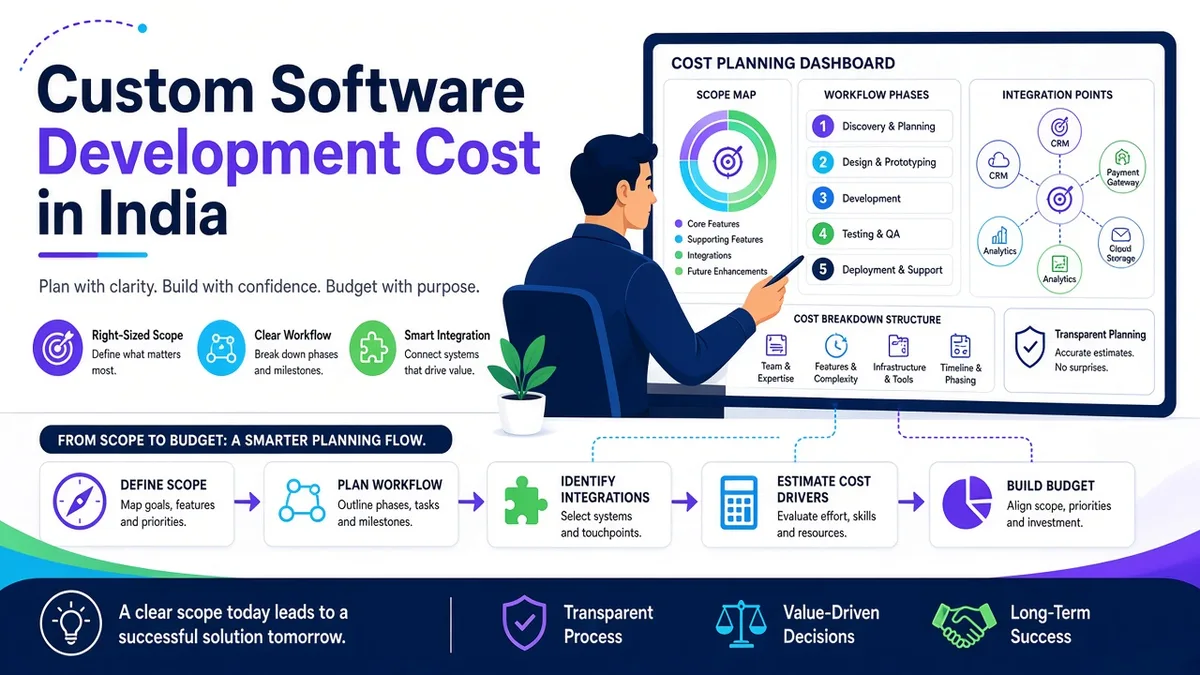 Articles
Custom software development cost in India
Learn what custom software costs in India, from MVPs to enterprise systems. See price ranges, cost factors and ways to save before you hire.
Learn more Articles
Custom software vs off-the-shelf software
Compare custom and off-the-shelf software on cost, speed, security and scalability. Use our checklist to decide what fits your business.
Learn more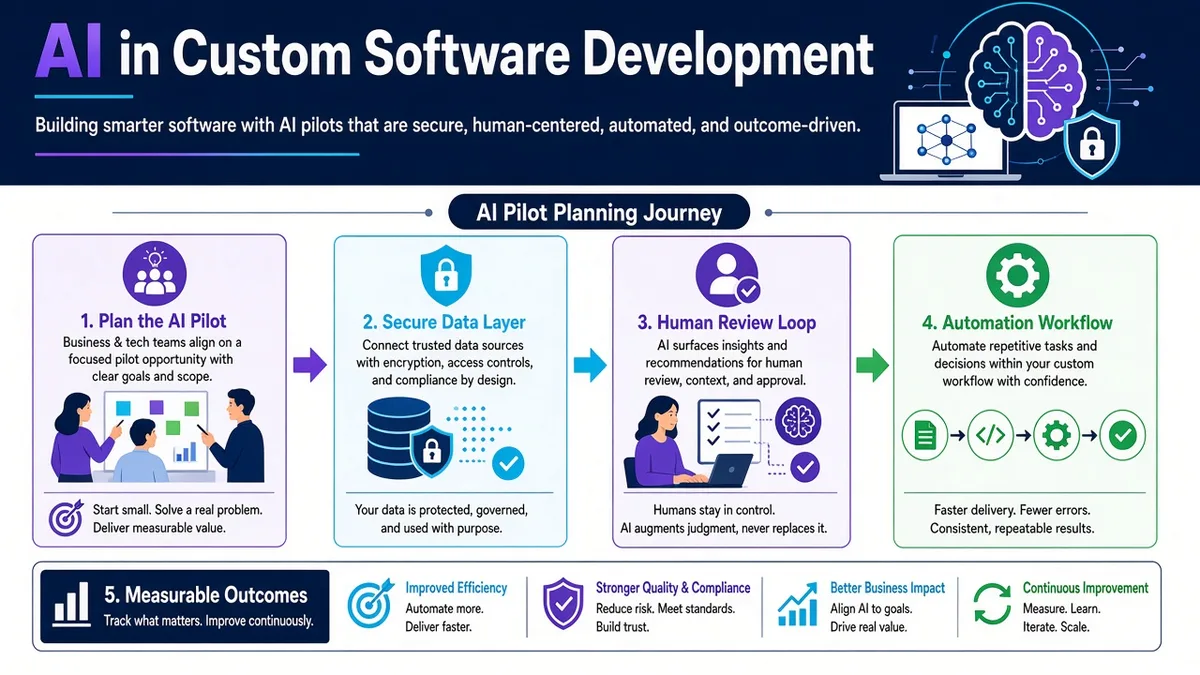 Articles
AI in custom software development
See where AI adds real value in custom software, from chatbots to automation. Learn costs, risks and how to start with a small pilot.
Learn more