Content marketing agency in India

Most content agencies send a generalist writer, give them a keyword, and hope. If you sell software or IT services, you've probably seen the result: blog posts your own engineers are a bit embarrassed by. We're a software company, so our writers can sit with your architects, understand what they're saying, and turn it into content that both Google and your buyers take seriously.

Get a Free Estimate
  • WordPress
  • Google Search Console
  • Semrush
  • Ahrefs
  • Google Analytics
Content marketing agency in India
300+ projects delivered across software, web and marketing
6+ years building digital products for businesses
15+ industries, from IT services to healthcare
Lucknow & Toronto where our two teams sit
Client results

What content has done for our clients

Numbers come from our clients' Search Console, GA4 and CRM.

IT Services · Noida

Mid-market IT company, 200–500 employees

Non-brand organic

+218%

vs. 12 months prior

Demo requests influenced

47

in the last 6 months

The story

Blog was 40 thin posts averaging 300 words, no internal linking, no author bios. We consolidated duplicates, rewrote 12 posts around real client questions, added author bios and schema markup, and built one cloud migration pillar page. Non-brand organic traffic more than tripled in under a year.

Healthcare SaaS · Bangalore

Patient-management SaaS selling to hospital CXOs

Keywords on page one

134

from 11 at kickoff

Time taken

9 months

to first-page ranking

The story

Hospital buyers search for compliance-heavy terms nobody was writing about. We built a 12-piece pillar cluster around "HIPAA-compliant patient records" and "hospital data retention", interviewed their CMO for each piece, and mapped every article to a real buyer question. 134 keywords now on page one, including six in the top three.

Manufacturing · Pune

Precision engineering firm, B2B industrial buyers

Deals using case study

23

in 8 months

Pipeline influenced

₹4.2 Cr

across 23 open deals

The story

Sales had no written proof for a 6-month buying cycle. We interviewed 4 clients, wrote 4 detailed case studies with real numbers and signed client quotes, and created a PDF version for the sales team. Within 8 months those case studies were attached to 23 active deals worth ₹4.2 Cr — the sales team now sends one on almost every second call.

Sound familiar?

Eighty blog posts, and sales has never sent one to a prospect

We see this a lot with IT and software companies. There's a blog, it gets updated, and somebody checks the traffic every month. But when a salesperson needs something to send a hesitant CTO, there's nothing that fits. Usually it comes down to one of these.

Written by people who don't know the product

A writer with no technical background, a keyword and two competitor articles to "take inspiration" from. It reads fine to a layperson and hollow to anyone who'd actually buy.

Topics picked by search volume alone

"What is cloud computing" gets lots of searches. It also attracts students writing assignments. Meanwhile the questions your buyers ask on discovery calls go unanswered.

Measured by page views and nothing else

Nobody knows whether a single article helped close a deal, so content is the first budget to get cut when things get tight.

The basics

Content marketing vs SEO: what's the difference?

Short version? SEO is about being found. Content marketing is about being worth finding.

A case study your salesperson emails to a nervous CTO is content marketing. It'll never rank for anything, and it might still close the deal. A founder's LinkedIn post that gets your name into a procurement head's feed is content marketing too. Google has nothing to do with either.

SEO, on the other hand, includes plenty that isn't content at all. Site speed. How your pages link to each other. Whether Google can even crawl half your site. We've seen lovely articles stuck on page four because the website underneath them was a mess.

Most of what we do sits where the two overlap, which people call SEO content marketing. Our SEO content marketing services are built for that overlap: we find what your buyers are searching for and write something better than what's already ranking. And since Softfix builds websites as well, if the site's the problem, we can fix that too.

Content marketing versus SEO comparison

Found vs worth finding

Where content and SEO overlap, that's where we work

Writer interviewing an engineer over a call

One 20–30 min call

Your expert speaks, we turn it into an article

How we write

Content written with your experts, not around them

Google's E-E-A-T guidelines reward first-hand experience. So do buyers. The only way to get that into an article is to talk to the people who have it.

For most pieces, one of our writers does a 20 to 30 minute call with someone on your team. That might be a solutions architect, your head of delivery or a doctor if you're in healthcare. We record it, pull out the real stories and opinions, and build the article around those. Your expert reviews the draft for accuracy, and that's usually all the time we need from them.

Because we write software ourselves, our writers can follow a conversation about microservices, data pipelines or HL7 integration without needing everything explained twice. Code samples get tested. Architecture diagrams get drawn properly. When something is technically wrong, someone on our side usually catches it before your engineer has to.

Articles go out under the name of the person who knows the subject, with a short bio. It's better for E-E-A-T, and frankly it's better for your team's own profiles too.

Content strategy mapped to buying intent

What your buyer reads depends on where they are

A CTO who's just noticed a problem needs very different content from one choosing between three vendors. Pick a stage to see what we'd write for a typical IT services company.

Content Marketing Strategy

Noticing a problem

"Why does our app slow down every time traffic spikes?"

They don't know what they need yet, just that something hurts. Content here explains the problem clearly and makes them feel understood.

  • Explainer blog posts and short guides
  • Founder or engineer LinkedIn posts on a common mistake
  • Pillar pages that cover the topic broadly

Measured by non-brand traffic and newsletter or LinkedIn follows.

Exploring solutions

"Should we move to Kubernetes or just scale our VMs?"

Now they're weighing approaches. They want honest trade-offs, ideally from someone who's done it before.

  • Technical deep dives and comparison articles
  • Whitepapers and downloadable checklists
  • Webinars with your engineers

Measured by downloads, return visits and assisted conversions.

Comparing vendors

"Which partners have actually done this for a company our size?"

They have a shortlist and want proof. This is where most companies have nothing, and where content does the most for sales.

  • Case studies with real numbers
  • Service pages that explain how you work
  • "X vs Y" pages written fairly

Measured by contact form and demo requests from these pages.

Ready to decide

"What exactly happens in the first 90 days if we sign?"

They need to convince their boss or finance team. Content here answers the last objections and makes the internal pitch easy.

  • Onboarding and process pages
  • Pricing explainers and ROI one-pagers
  • Security and compliance documents sales can send

Measured by how often sales uses it and deals it was part of.

Our services

Content marketing services we offer

We mostly provide B2B content marketing services for lead generation, which means content built to help a buyer move toward a sales conversation. Some clients come to us for content strategy services only and have their own writers. Others want everything from the first audit to the last proofread. Both work.

Content strategy mapped to buying intent

We talk to your sales team, read call notes, look at search data and check what competitors rank for. The result is a content roadmap tied to the questions buyers ask at each stage, not a list of keywords with search volumes next to them.

Content audit and content gap analysis

Every page on your site gets a verdict: keep, update, merge or remove. Then we compare what you have with what your buyers search for and what competitors cover, and list the gaps worth filling first.

Topic cluster and pillar page development

One in-depth pillar page per core service, surrounded by shorter articles that link back to it. Google understands what you're an authority on, and readers can go as deep as they want.

Editorial calendar planning and management

A shared calendar with every piece, its owner, its expert, its deadline and its funnel stage. We run it, chase the reviews and keep publishing on schedule even when your team gets busy.

Technical blog writing for software companies

Articles on cloud, DevOps, data, security and software architecture, written by people who can read your code and checked by your engineers. Code samples are tested before they're published.

Case study and whitepaper development

We interview your client (and your delivery team), get the real numbers and write case studies that sales actually wants to send. Whitepapers get designed properly, not pasted into a Word template.

Content production workflow

Brief, expert call, draft, technical review, edit, SEO check, design, publish. Everyone knows what's expected and when, and content governance rules keep your terminology and claims consistent.

Non-brand organic traffic growth through content

Traffic from people who didn't already know your name is the part that grows the business. We track it separately from brand searches, so you can see whether content is actually bringing in new people.

Content performance analytics and attribution reporting

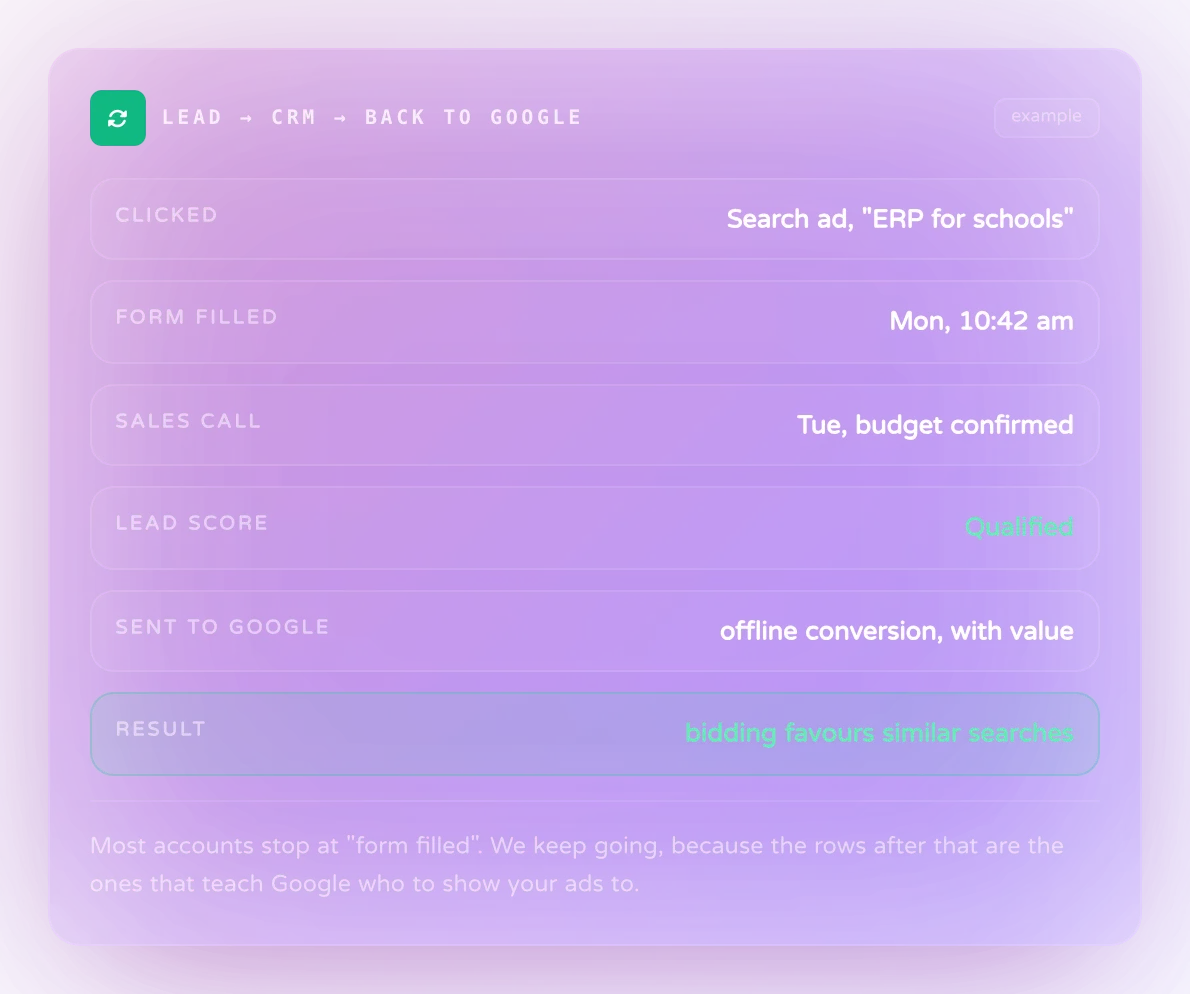
GA4, Search Console and your CRM in one dashboard our developers build. You'll see which articles were read before a demo request and which ones are just collecting dust.

Content creation services

What we write

Different formats do different jobs. We'll tell you which ones are worth it for your business, and which aren't.

Blog writing

Articles that answer real questions in depth, usually 1,500 to 2,500 words, with diagrams where they help. Fewer, better posts beat a weekly filler schedule.

Pillar pages

Long, well-organised guides to your main service areas. They take more effort than a blog post and tend to keep earning traffic for years.

Case studies

Case study writing services for software companies, built from interviews with your client. Problem, approach, numbers, and a quote that doesn't sound like it came from a press release.

Whitepapers and guides

Gated or ungated, depending on whether you need leads or reach. We'll help you decide which, honestly.

Thought leadership content

Our thought leadership content services cover LinkedIn posts and opinion articles for your founders and senior engineers, ghostwritten from conversations with them, so it actually sounds like them.

Technical content for cloud

Technical content writing services for cloud companies and partners. AWS, Azure and GCP migrations, cost optimisation, architecture patterns. Accurate enough for engineers, clear enough for the people who sign off budgets.

Content audit and content gap analysis services

Before we write anything new, we look at what you already have

Most sites have more content than they need and less than they should. An audit usually turns up a handful of old posts that only need a refresh to start ranking again, which is the cheapest win in content marketing.

KEEP

Keep

Pages that rank, convert or get used by sales. We leave them alone apart from small fixes.

UPD

Update

Pages that used to perform or almost rank. New data, better examples, fresh internal links.

MRG

Merge

Three thin posts on the same topic competing with each other. We combine them into one strong page.

DEL

Remove

Outdated or off-topic pages that drag down the rest of the site. Redirected properly, so nothing breaks.

The gap analysis

Compares your content with three things: the questions your sales team hears, the searches your buyers make, and what your top competitors cover that you don't. Gaps get ranked by how close they are to a buying decision, not just by search volume.

Practical guide

How to build a content marketing strategy for a B2B company

Skip the keyword tool for now. Go and sit with your sales team for an hour instead.

Ask them what prospects ask on the first call. Ask which objection kills the most deals. Ask what they wish they had to send after a meeting, the thing they keep explaining over and over on Zoom. Write all of it down. Honestly, that list is half your strategy already.

Now sort those questions by where the buyer is. Some come from people who've only just noticed a problem. Some come from people comparing three vendors, and a few from someone who's basically ready to sign. You'll probably find your blog is full of early-stage stuff and has almost nothing for the last two groups. Most B2B companies are in the same boat, and it's the gap that hurts sales the most.

Then open the keyword tool. Find the searches behind each question, look at what's ranking, and be honest about whether you can beat it. Group related topics around a pillar page so Google gets a clear picture of what you know.

Two more things people skip. Decide how you'll measure success before you publish, not six months later. And don't promise yourself twelve posts a month if your experts can barely make time for four. Four good ones, every month, for a year, will beat any burst of enthusiasm.

Team planning content marketing strategy around a table

Start with sales

The first-call questions are your strategy brief

Monthly editorial calendar on a desk with notebooks

Plan a quarter

Every piece has owner, expert, deadline, stage

Practical guide

How to create an editorial calendar for B2B content

Plan a quarter at a time. A full year is too far out, and a month is too short to get anything substantial written.

Start with what the business is doing that quarter. A launch? A new city? A trade show in Bengaluru? Your calendar should push in the same direction, otherwise content and sales end up talking about completely different things.

For every piece, note the topic, who it's for, the funnel stage, the keyword, the expert and the writer. Then add three dates, for draft, expert review and publish. The review date is the one that'll slip, every time, because your architect has a production issue or your doctor is in OPD. Book their interview slot early and leave a week of slack.

Don't stack four beginner posts in a row. Mix the stages. And keep a slot or two every month for refreshing old posts. Updating something stuck on page two is often a better use of a writer's week than starting from scratch.

Keep the whole calendar in one place everyone can see, experts included. A spreadsheet is fine. What matters is that people actually open it.

Content workflow and governance

How a piece of content moves through our team

Eight steps, and the only one that needs real time from your side is the expert call.

  1. 01

    Brief

    Reader, intent, keyword, angle, links, next step.

  2. 02

    Expert call

    20 to 30 minutes with someone on your team.

  3. 03

    Draft

    Written around what the expert actually said.

  4. 04

    Technical review

    Checked by our team, then by your expert.

  5. 05

    Edit

    Tightened, fact-checked and matched to your style guide.

  6. 06

    SEO and links

    Headings, metadata, schema and internal links.

  7. 07

    Design and publish

    Diagrams, images and formatting, then live.

  8. 08

    Refresh

    Reviewed every six to twelve months.

Measuring results

How to measure content marketing ROI

Here's the problem. Content almost never gets the last click before someone fills a form. So if you only look at last-click reports, your blog looks like a waste of money, even when it isn't.

Non-brand organic traffic. People who found you without knowing your name. We separate this from brand searches, since brand traffic would come anyway.

Assisted conversions. How often someone read a piece of content before filling in a form, even if they converted on a different page or a different day.

Content attribution in your CRM. Our developers pass the pages a lead read into your CRM, so you can see which articles show up in deals that closed.

Sales usage. How often case studies and guides get sent by your team. It's a simple number, and a surprisingly honest one.

The number that matters

Add up the pipeline those articles touched, put it next to what you spent, and you've got a number finance will at least take seriously. Is it perfect? No. Content attribution never is. But it's a lot closer to the truth than page views.

Content marketing analytics dashboard

Pipeline, not pageviews

The number your CFO will actually read

Industries

Who we write for

Content marketing for IT services companies

Managed services, consulting and outsourcing firms that need to show real delivery experience. Case studies and technical articles do most of the work here.

Software and SaaS

Product-led and sales-led companies. We write for developers, for buyers, and for the person stuck between them who has to justify the purchase.

Cloud and DevOps

Cloud consultancies, MSPs and partners. Migration guides, cost optimisation, architecture patterns, all reviewed by people who've done the work.

Content marketing for healthcare

Hospitals, clinics, diagnostics and health-tech. Medically reviewed, carefully worded, and written so patients can actually understand it. Health topics are held to a higher standard by Google, and we write with that in mind.

B2B manufacturing and engineering

Technical products with long buying cycles and committees. Spec-heavy content that engineers trust, plus simpler versions for the people signing the purchase order.

Fintech and professional services

Topics where accuracy matters and compliance teams want to see everything. We work with your review process, not around it.

Process

What the first 90 days look like

Content takes time to show results in search, usually a few months. So we front-load the work that helps sooner, like refreshing old posts and giving sales something to send.

  1. 01

    Days 1–15 · Audit and interviews

    Content audit, gap analysis, and conversations with your sales team and a couple of your experts. Analytics and CRM tracking checked so we can measure from day one.

  2. 02

    Days 16–30 · Strategy and calendar

    Topic clusters, priorities and the first quarter's editorial calendar, agreed with you. The first refreshes of old content go live.

  3. 03

    Days 31–60 · First new pieces

    The first pillar page and supporting articles get published, plus one case study for sales. The workflow settles into a rhythm.

  4. 04

    Days 61–90 · Review and adjust

    First look at rankings, non-brand traffic and assisted conversions. We adjust the next quarter's calendar based on what's working.

Pricing

How much do content marketing services cost?

It depends mostly on how technical the content is, how many pieces you need a month, and whether you want strategy and measurement or just writing. A deep technical article with an expert interview costs more than a general blog post, and it's usually worth it.

Strategy and audit

₹ one-time

Content audit, gap analysis, topic clusters and a three-month editorial calendar. Yours to run in-house or with us.

Content programme · Featured

₹ / month

Strategy, editorial calendar, __ pieces a month with expert interviews, SEO and monthly reporting.

Content and attribution

₹ / month

Everything in the programme, plus case studies, whitepapers, thought leadership and a CRM-linked attribution dashboard.

Why Softfix

Why companies choose Softfix as their content marketing agency

Writers who understand tech

We build software for a living. Our writers can follow your engineers, and our developers check the technical bits before your team has to.

Planned around sales

We start with the questions your buyers ask, so the content is useful to your sales team as well as to Google.

Measured by pipeline

Non-brand traffic and assisted conversions come first in our reports. Page views are there too, but they don't lead.

Light on your experts' time

One short call per piece and a review. We do the rest and chase the deadlines.

We fix the website too

If slow pages or poor structure are holding your content back, our web team can fix that, without you hiring anyone else.

Contract terms

Our minimum term and notice period are spelled out in the proposal, in plain words, before you sign anything.

FAQ

Frequently asked questions

What do content marketing services include?

Depends who you ask. For us it's strategy, an audit of what you've already got, the editorial calendar, writing, editing, SEO, publishing and reporting. We also interview your experts for each piece, and link the content to leads in your CRM so you can see what it did.

What is the difference between content marketing and SEO?

SEO is about being found in search. Content marketing is about being worth reading, wherever someone comes across you. A case study sent by sales is content marketing but has nothing to do with SEO. Site speed is SEO but has nothing to do with content. Most of our work is where the two overlap.

How much do content marketing services cost?

Mostly it comes down to how technical the content is and how much of it you need. Our one-time strategy and audit starts at a fixed fee, and monthly programmes start at a monthly retainer. A deep cloud architecture piece costs more than a general blog post, and it should.

How do you build a content marketing strategy for a B2B company?

Talk to sales first. Find out what buyers ask and what makes deals stall. Sort those questions by how close the buyer is to deciding, then use search data to find the keywords behind them. Group topics around pillar pages, decide how you'll measure it, and pick a pace your team can keep up.

How do you measure content marketing ROI?

Not with page views. We look at non-brand traffic, assisted conversions in GA4, and which articles a lead read before they got in touch, which our developers pass into your CRM. Then we compare the pipeline that content touched with what you spent on it.

How long does content marketing take to show results?

Refreshing old posts can move things in a few weeks. Brand-new articles usually take three to six months to rank, longer if your competitors are big. Case studies are different. Sales can use them the day they're done.

Do you write technical content for software and cloud companies?

Yes, that's most of our work. Our writers sit next to our own developers, so a conversation about Kubernetes or API rate limits doesn't lose them. Your engineers still check every draft before it goes live.

How much of our team's time will this take?

Less than you'd think. One 20 to 30 minute call with your expert per piece, then they read the draft. Someone also needs to sign off the calendar once a quarter. That's about it.

Do you write case studies?

Yes, and we like doing them. We talk to your client and the team that did the work, get the numbers approved, and write it as a story about a real problem. Sales usually wants a PDF version too, so we design that as well.

What is a topic cluster?

A bunch of articles on related questions, all linking to one big pillar page on the main subject. Google gets a clearer idea of what you're an expert in, and readers can keep going deeper without hunting around your site.

Do you do content marketing for healthcare?

We do. Health content gets judged more strictly by Google, and patients deserve accuracy anyway. Your doctors or clinical team review every piece before it's published, no exceptions.

Will the content be original?

Completely. Each piece comes from a brief and a conversation with your own expert, so it's built on what your company actually knows. We don't rewrite competitor articles.
Free content audit

Find out which of your pages are worth saving.

Send us your website. We'll look at what's ranking, what's slipping, and where the biggest gaps are compared with your competitors, then walk you through it on a call. Keep the findings whether or not we work together.

Email

[email protected]

Phone

+91 81890 10046

Response time

We reply within one business day.

We reply within one business day.

Call WhatsApp