


Custom software development cost in India cannot be estimated responsibly from a keyword, a screen count or a generic market range. A useful estimate needs scope data about users, workflows, integrations, quality, risk and ownership. This guide explains how to gather that evidence, compare proposals and decide what to build first.
- Scope data matters more than a vendor’s headline rate.
- A phased estimate makes unknowns visible before they become change requests.
- Separate one-time delivery from the ongoing cost of operating the product.
General scenario (not a Softfix case study)
Imagine a growing organisation whose teams rely on spreadsheets, email and separate systems for a workflow that is becoming difficult to control. The useful first move is not to assume that a particular product or vendor is right. Map the current steps, identify the costly exception and test a narrow improvement with the people who do the work.
This scenario is illustrative guidance, not a report of Softfix work or a promise about a particular result. Its lesson is to connect a proposed capability to evidence: a baseline, a user need, a risk control and an owner. The same discipline applies whether the decision is to buy, build, partner or introduce an AI-assisted feature.
Custom software development cost in India: what “cost” should include
A build quote covers more than coding. Discovery, user experience, architecture, project management, testing, deployment, documentation, training and early support all affect the total. Ask whether each is included, optional or deferred. A low headline number can simply mean that important work has been moved outside the quote.
Separate one-time delivery from ongoing ownership. Hosting, licences, monitoring, support, security updates and third-party usage charges may recur. Put them beside the delivery estimate from the start so a cheap launch does not become an unexpectedly expensive operating model.
Read the estimate as a model of responsibilities, not just a total. For every major line, identify the person who supplies decisions, content, access, test data and acceptance. Delays in those inputs can affect the real cost even when the development scope has not changed. A proposal is easier to review when delivery work and client-side responsibilities are written beside one another.
For a budget review, translate each assumption into a line item finance can challenge. State whether it is one-time or recurring, what evidence supports it and what discovery could change it. If scope data is missing, record the question and plan the investigation rather than presenting a made-up figure.
Keep a short record of budget decisions as the product develops. When a capability is deferred, note the reason and the condition that would bring it back into scope. This prevents the estimate from becoming a static document and helps the next planning conversation start with what the team actually learned.
The five drivers behind an estimate
The first driver is scope: number of roles, workflows, screens and edge cases. The second is integration: every external system brings authentication, rate limits, data mapping and failure handling. The third is quality: a public banking workflow needs more assurance than a private prototype. The fourth is timeline pressure. The fifth is the maturity of the requirements.
Ask a provider to show the relationship between each driver and the estimate. “The project costs more because it is complex” is not actionable. “The payment reconciliation needs two-way sync and manual exception handling” is actionable because your team can decide whether that capability belongs in version one.
For a budget review, translate each assumption into a line item finance can challenge. State whether it is one-time or recurring, what evidence supports it and what discovery could change it. If scope data is missing, record the question and plan the investigation rather than presenting a made-up figure.
Keep a short record of budget decisions as the product develops. When a capability is deferred, note the reason and the condition that would bring it back into scope. This prevents the estimate from becoming a static document and helps the next planning conversation start with what the team actually learned.

How Indian development pricing is usually structured
Indian teams may quote fixed price, time and materials, a monthly pod, or a hybrid. Fixed price works when the scope and acceptance criteria are stable. Time and materials works when discovery will change the backlog. A pod works when you need a continuing product team. None is automatically safer; governance and transparency matter more.
Compare the people assigned, not just the blended rate. A senior architect for a few hours, experienced delivery ownership, QA involvement and accessible product communication can prevent costly rework. Request a role-by-role assumption list and ask who makes technical decisions when the plan changes.
Currency conversion is only one part of comparing an overseas proposal. Check tax treatment, payment mechanics, working-hour overlap, communication channels and who can approve changes. Also ask how handoffs will work when a specialist is unavailable. These details do not determine quality by themselves, but unclear operating arrangements can create coordination work that was absent from the headline estimate.
For a budget review, translate each assumption into a line item finance can challenge. State whether it is one-time or recurring, what evidence supports it and what discovery could change it. If scope data is missing, record the question and plan the investigation rather than presenting a made-up figure.
Keep a short record of budget decisions as the product develops. When a capability is deferred, note the reason and the condition that would bring it back into scope. This prevents the estimate from becoming a static document and helps the next planning conversation start with what the team actually learned.
Budget planning without invented ranges
The table below is a planning framework, not a price promise. Labels such as “MVP”, “portal” or “enterprise system” do not contain enough information to calculate a responsible budget. The right estimate depends on the actual workflows, data, integrations, quality expectations and operational responsibilities.
A narrow internal workflow can be a sensible first release even when the long-term platform is large. Define the user outcome, the smallest safe workflow and the measure that proves it works. Then reserve room for learning instead of treating uncertainty as zero.
For a budget review, translate each assumption into a line item finance can challenge. State whether it is one-time or recurring, what evidence supports it and what discovery could change it. If scope data is missing, record the question and plan the investigation rather than presenting a made-up figure.
Keep a short record of budget decisions as the product develops. When a capability is deferred, note the reason and the condition that would bring it back into scope. This prevents the estimate from becoming a static document and helps the next planning conversation start with what the team actually learned.
| Decision | Option A | Option B | Watch for |
|---|---|---|---|
| Small internal workflow | One team, few roles | Multi-team platform | Unclear ownership |
| Customer portal | Known data and login | Multiple integrations | Migration quality |
| MVP | One measurable outcome | Several channels | Feature growth |
| Enterprise system | Phased rollout | Complex permissions | Compliance scope |
A simple estimation process
Start with a one-page brief: users, business outcome, current workaround, must-have workflow, integrations, data sensitivity and launch constraint. In discovery, turn that brief into journeys and acceptance criteria. Then split the work into thin vertical slices that can be demonstrated and tested.
Estimate each slice with assumptions and confidence. Mark items as known, likely or unknown. Price unknowns as discovery tasks or explicit contingency. This is more honest than hiding uncertainty inside a large fixed number, and it gives stakeholders a decision at every stage.
Review the estimate at the end of each discovery or delivery milestone. Compare planned work with what was learned, then record whether the next slice should be kept, reduced, redesigned or deferred. This creates a traceable path from evidence to budget and makes it easier to explain changes to finance, operations and leadership without pretending that early uncertainty was avoidable.
For a budget review, translate each assumption into a line item finance can challenge. State whether it is one-time or recurring, what evidence supports it and what discovery could change it. If scope data is missing, record the question and plan the investigation rather than presenting a made-up figure.
Keep a short record of budget decisions as the product develops. When a capability is deferred, note the reason and the condition that would bring it back into scope. This prevents the estimate from becoming a static document and helps the next planning conversation start with what the team actually learned.
How to reduce cost without reducing value
Reduce breadth before reducing quality. Remove secondary roles, reports and integrations from the first release; keep security, backup, accessibility and reliable error handling. Reuse proven platform components where they fit, but do not force a generic workflow onto a process that creates your competitive advantage.
A smaller first release also improves feedback speed. Agree on a change-control rule: new requests are recorded, sized and traded against something else. That rule protects the budget while keeping the product responsive to what users learn.
For a budget review, translate each assumption into a line item finance can challenge. State whether it is one-time or recurring, what evidence supports it and what discovery could change it. If scope data is missing, record the question and plan the investigation rather than presenting a made-up figure.
Keep a short record of budget decisions as the product develops. When a capability is deferred, note the reason and the condition that would bring it back into scope. This prevents the estimate from becoming a static document and helps the next planning conversation start with what the team actually learned.

Quick checklist
- ☐ Write the outcome in one sentence.
- ☐ List users and roles.
- ☐ Name every external integration.
- ☐ Separate one-time and recurring costs.
- ☐ Record operating costs and owners.
- ☐ Define acceptance tests before development.
Questions to ask before accepting a quote
Ask what is excluded, how assumptions are tested, when you receive the source code, how defects are handled, what happens when an API changes and who owns the accounts. Ask for a sample milestone report rather than a promise that “communication will be good”.
Check whether the proposal describes measurable acceptance criteria. “Build dashboard” is vague; “finance manager can filter paid invoices by date, export a CSV and see a friendly empty state” can be tested. Good detail is a sign of delivery discipline, not needless paperwork.
Ask how the estimate treats non-functional work. Confirm expectations for response time, permissions, audit trails, browser support, backups, monitoring and accessibility where they matter to the workflow. These items may not be visible in a feature list, yet they influence design, testing and the effort required to operate the product confidently.
For a budget review, translate each assumption into a line item finance can challenge. State whether it is one-time or recurring, what evidence supports it and what discovery could change it. If scope data is missing, record the question and plan the investigation rather than presenting a made-up figure.
Keep a short record of budget decisions as the product develops. When a capability is deferred, note the reason and the condition that would bring it back into scope. This prevents the estimate from becoming a static document and helps the next planning conversation start with what the team actually learned.
| Check | Evidence | Owner |
|---|---|---|
| Outcome | Baseline and target are written | Product owner |
| Risk | Unknowns have a test or contingency | Delivery lead |
| Handover | Access and documentation are agreed | Operations |
A budget template you can reuse
Create columns for capability, user, business outcome, dependency, acceptance test, delivery phase, one-time effort, recurring cost, owner and confidence. Add a decision log for choices that influence cost, such as native versus cross-platform, managed versus self-hosted services, or manual versus automated reconciliation.
Finally, have someone outside the build team challenge the assumptions. Finance can check recurring costs. Operations can confirm the workflow. Security can identify controls. The goal is not a perfect forecast; it is a forecast that improves as evidence arrives.
Include a confidence note beside each forecast rather than presenting every number with equal certainty. A known licence renewal, an untested integration and a future optimisation should not be treated as the same kind of commitment. When the team revisits the budget, it can focus its investigation on the assumptions with the largest potential effect instead of rechecking every line equally.
For a budget review, translate each assumption into a line item finance can challenge. State whether it is one-time or recurring, what evidence supports it and what discovery could change it. If scope data is missing, record the question and plan the investigation rather than presenting a made-up figure.
Keep a short record of budget decisions as the product develops. When a capability is deferred, note the reason and the condition that would bring it back into scope. This prevents the estimate from becoming a static document and helps the next planning conversation start with what the team actually learned.

Make the next decision smaller
If you want an estimate that can be defended internally, start with a short discovery brief rather than asking for a blind quote. Include the current workflow, desired outcome, constraints and available evidence so the estimate can be refined instead of guessed.
Conclusion: Custom software development cost in India
Good decisions come from a clear outcome, stated assumptions and a small way to learn before committing to more work. Use the framework in this guide to document what is known, test what is uncertain and agree who will own the result after launch.
Keep reading: Custom software vs off-the-shelf software · How to choose a custom software development company · AI in custom software development
Related articles
 Software Development
Custom Software Development
Build scalable custom software Personalised to your business needs. Softfix delivers CRM, ERP, workflow automation, API integration and cloud-based solutions.
Learn more Articles
Custom software vs off-the-shelf software
Compare custom and off-the-shelf software on cost, speed, security and scalability. Use our checklist to decide what fits your business.
Learn more Articles
How to choose a custom software development company
Use this checklist to compare software vendors on experience, pricing, code ownership and support. Includes red flags and questions to ask.
Learn more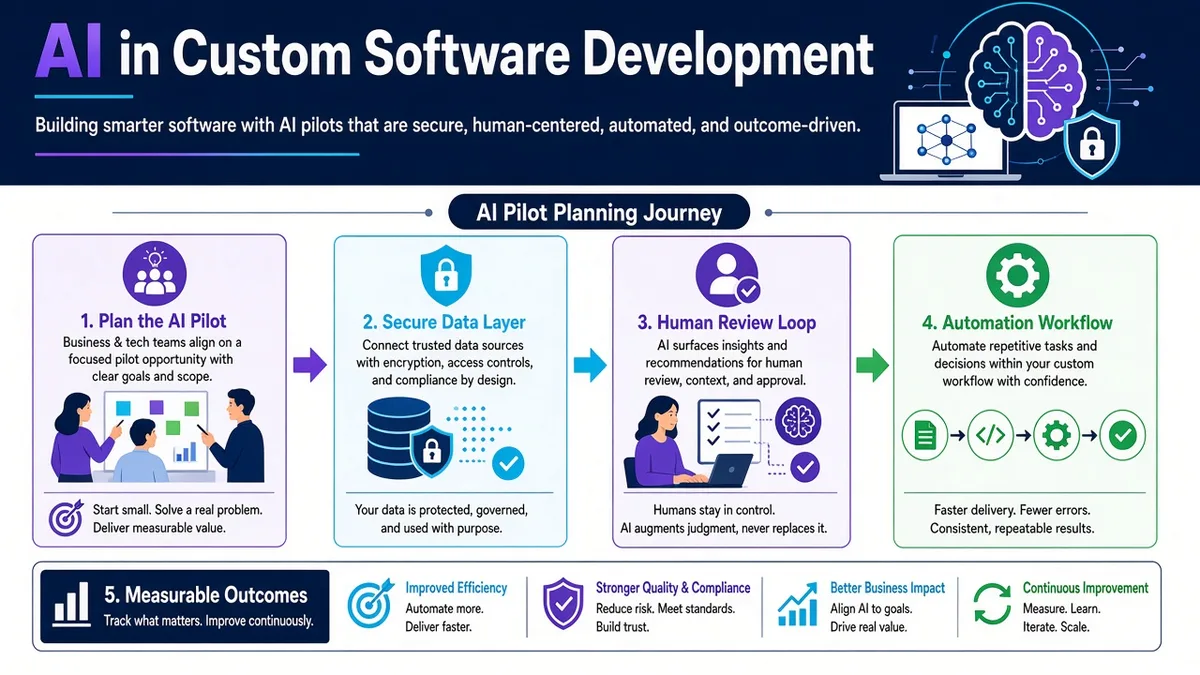 Articles
AI in custom software development
See where AI adds real value in custom software, from chatbots to automation. Learn costs, risks and how to start with a small pilot.
Learn more